


Elefant Travel will be the pioneer agency that will carry out the first Spanish charter flight to the North Pole in an airship
Almost a century later, the epic adventure of flying and landing at the geographic North Pole with a blimp can become a reality. Imagine leaving Svalbard on board a state-of-the-art airship, spending the night on board while flying smoothly and quietly, and waking up and having breakfast in one of the most remote places on earth. And all this in a sustainable flight with a minimal carbon footprint.
On May 12, 1926 the Norwegian explorer Roald Amundsen flew over the North Pole for the first time on board the Norge airship, which landed the next day in Alaska. The airship was piloted by the Italian Umberto Nobile. He wanted to repeat the experience after two years aboard the dirigible Italia, in an expedition that was not successful.
Many planes and ships left to rescue the Italian expedition, among them a seaplane in which Amundsen was travelling. Nobile was found alive, but Amundsen’s seaplane disappeared in the Barents Sea on June 18, 1928 without a trace of the explorer.
In Spain, Elefant Travels wants to make this dream come true with the help of the Swedish company OceanSky. The agency will charter the first charter in Spain, in an airship to the North Pole in the year 2024. Its founder, Gonzalo Gimeno, who will travel on that first Spanish flight, has been named “OceanSky Ambassador”, and his mission is to spread those values related to a new type of sustainable aviation and to contribute to making this new industry a reality very soon. The travellers on this exclusive flight will be the ones who design the trip itself, making their contribution part of a pioneering history.



A 21st century airship
Gone are the rigid airships of a century ago that used hydrogen as fuel. OceanSky will use the Airlander 10, a lightweight, non-flammable helium-filled airship, on its North Pole expedition. The aircraft does not need an airport as it can land anywhere, even on water. It is the largest aircraft in the world, measuring almost 100 meters in length, and is powered by four propellers with full autonomy for days.
A blimp of these characteristics is subject to the same safety regulations as any passenger aircraft. The most critical phase of any flight is take-off and landing. The Airlander will land at 30km/h instead of the usual 230km/h of an aircraft.
In addition, you will be able to fly in a wide range of weather conditions. Just like an airplane, it will also be able to withstand extreme sub-zero temperatures and icy conditions. In the unlikely event of a failure of all the engines, helium would sustain the aircraft in the air and it could land in a controlled descent.


An epic journey to climate change’s zero
This fascinating and iconic journey also aims to raise awareness of the beauty and fragility of this unique land ecosystem that is the Arctic. The extent of the Arctic ice floe reaches record lows year after year. The ice surface by September 2019 has been reduced by 40% from that existing in 1979. The ice is melting, affecting not only its extent but also its quality. As it melts, seawater appears, which, being dark, attracts more of the sun’s rays, which in turn continue to melt larger areas of ice.
With this flight, we intend to demonstrate that airships can become an alternative to commercial tourist aviation by creating a new way of travelling, sustainable and not dependent on airports.
You will take off from Svalbard and enjoy an exclusive menu inspired by the Arctic and prepared on board by a prestigious chef. You will spend the night in flight, staying in comfortable, fully equipped cabins and will land in the morning at the North Pole. After landing, you will enjoy an Arctic expedition and return to Svalbard again, spending the night on board the airship.
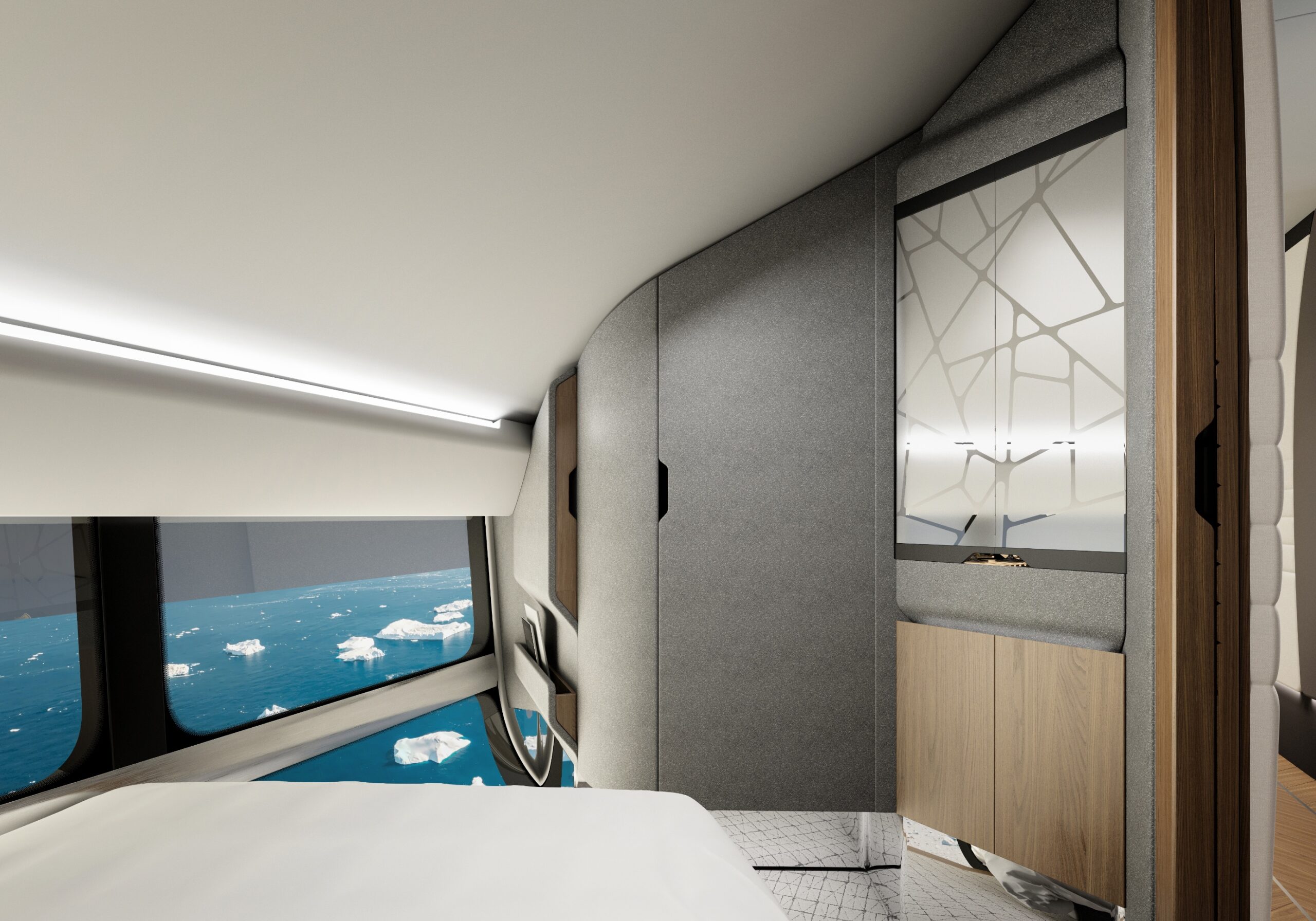
The passenger gondola has been designed as a luxury hotel in the sky, with large panoramic windows and all the comfort and amenities. The cabin is not pressurized, which provides a quiet environment on board, without turbulence and with a slow cruising speed at low altitude. Ideal to enjoy 100% of the trip and the landscape.




“The first Spanish flight has only 8 double cabins for the first pioneers, and is already available for the first reservations.”

