Primates have always fascinated humans because of their strong resemblance and close kinship with us. It was in the 18th century when the term primates (from the Latin “first”) began to be used, where we included people, monkeys, gorillas, and a long list up to lemurs. Initially at no time was it suggested that monkeys were relatives or ancestors of humans as this did not come until 1859, a hundred years later, with Darwin. The word primate was simply used to define those zoologically more developed organisms of the animal kingdom.
The world of cinema has brought us mythical films about primates such as Gorillas in the Mist, or the recent Virunga documentary. Anthropologists such as Diane Fossey, Jane Goodall or the Spanish Magdalena Bermejo in the Congo have been pioneers in showing the world an animal but tremendously human reality and have dedicated their lives to study, understand and protect our own evolutionary history.
When we think of Africa, we rarely imagine the treasures hidden in primate species, unfortunately in danger of extinction. In gorillas alone, there are two main species, mountain and valley gorillas, and four other subspecies.
But undoubtedly the most famous are the mountain gorillas, distributed in the rainforests between the Virunga volcanoes on the borders of Rwanda, Uganda and the Democratic Republic of Congo. They live at altitudes between 2,200 and 4,300 meters on the slopes of the Karisimbi, Mikeno and Visoke volcanoes where the vegetation is dense and abundant for their totally vegetarian diet.
Today they live confined in protected areas declared national parks and despite their critically endangered status, their population has been slowly growing to an estimated 880 individuals at present thanks to the efforts of different organizations and investments in the development of the protected areas where they live. But it is mainly thanks to the income generated by tourism that our close relatives are protected.
There are three types of gorilla groups. Those totally wild, others semi-habituated to human presence to which only researchers have access and the so-called habituated ones. Over time, the latter groups of gorillas have been progressively habituated to the presence of humans once a day. For two years, the rangers spend long periods of time every day among different groups of gorillas so that they gradually become accustomed to human presence. As time goes by, several rangers approach the gorillas, usually at the same time of day to create a routine that is comfortable for everyone. This regular contact allows better control and anticipation of possible diseases. The loss of a single gorilla is a great impact given the very low number of individuals.
This two-year process allows us to later bring in honored guests interested in having a close encounter with them in their natural environment.

You have to get up early to reach the control station of the national park. Once there, the rangers form small groups of 8 to 12 people to start trekking to the different gorilla groups. Each group of visitors heads towards a specific family of habituated gorillas who, depending on the time of year, will be found closer to the valley picking berries and wild fruits or higher up.
Because of the danger of transmission of human diseases to the gorillas, access is not allowed to anyone with medical symptoms or even a slight cold. In the case of visits to the Congolese area, the use of masks is mandatory. For the trekking, it is necessary to wear good boots, long pants and long sleeves, since you have to go deep into the rainforest and in many occasions you will have to make your way as you go along.
To ensure the success of the visit, a group of trackers leave a few hours in advance to locate the different groups of gorillas and guide the groups of visitors by radio. Depending on where they are, the walk may be longer. Even so, going deep into the dense vegetation is a magical experience in itself.
At one point, the rangers indicate where we should leave our backpacks and especially the food we carry. We will take our camera with us since we will only have about 45 minutes to live the moment. At this point we must lower our voices and go in single file towards the direction that the specialist guide will show us. It is at this moment when we feel the heart beat a little stronger from the excitement, and we begin to hear the sounds of the jungle in a different way. The atmosphere is very humid and fresh and we will feel the tiredness in our legs because we will have already climbed several hundred meters to reach this point.
The visit is organized to the millimeter by specialists to reach the group at noon. The gorillas rest and make a stop in their day. This time is very important to establish social relationships among them, games and hygiene tasks and without a doubt the best time to visit them. Once spotted, we will approach slowly and crouch down in a submissive position with the head looking down at first. It is common for the dominant male, the silverback, to approach to make it clear who has the authority in the area and we have to make it equally clear that he is the one in charge.

A male can weigh up to 200 kg and reach an erect height of more than 2 meters. Gestation lasts 8 and a half months and between 3 and 4 years pass between each birth, since the young depend on the mother until their third or fourth year of age. Their life expectancy is between 30 and 50 years. This makes the recovery of populations very slow compared to other species.
For the next 45 minutes, we will be privileged spectators and guests of honor in the middle of the jungle, witnessing a day in the life of a family of mountain gorillas, being just a few meters away from them. The youngest, restless and curious ones will approach to watch us closely with the same look and curiosity that we will be watching them.
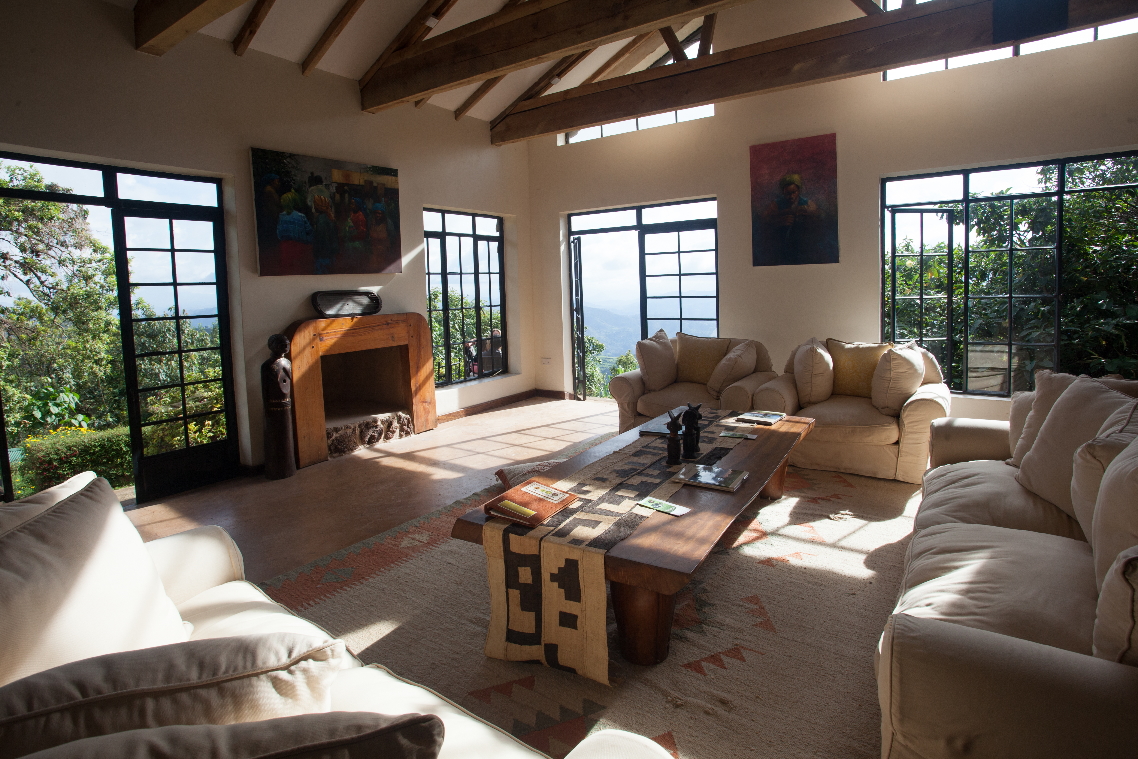
In Rwanda, the Wilderness Safaris company has recently opened the Bisate Lodge, with only 6 luxury cabins, setting a new benchmark for camping in the country. From here you can lead tours of the national park with specialized guides.
The minimum age to visit a gorilla group is 15 years old.
In Uganda, we can also have an encounter from Cloud’s Mountain Gorilla Lodge, with only 7 chalets, built at an altitude of over 2,000 meters with direct views of the jungle and the Virunga volcanoes. The area is called the Bwindi Impenetrable Forest (pronounced Buindi) and is home to the gorillas in Uganda. This area has access to 6 groups of habituated gorillas with a maximum quota of about 60 visitors per day divided into 6 groups of 10 people.

There is another species of gorillas called valley gorillas that inhabit the Congo River basin. The current population is estimated at about 20,000 individuals and one of the great anthropologists of our time, Magdalena Bermejo, is Spanish and directs a research project from the camp where guests can have a very special experience with valley gorillas in one of the most remote areas of the planet but staying in a camp with all the expected services and security and living a research project in first person. The camp is only accessible by light aircraft and allows you to have a very special experience in contact with nature as there are no tourists in the area. The most relevant are the visits to the gorillas from Ngaga’s camp. The experience is different from what we can live in Rwanda and Uganda. Here we are at low altitude and in the middle of a deep jungle. It is necessary to wear a mask so as not to transmit any possible disease to the gorillas, provide us with a good mosquito repellent and wear a mosquito net around our heads. On this occasion, the adventure is served because you have to go out to search, track and find the gorillas and this can become a nice walk, or a long hike. The jungle is already a grandiose spectacle in itself.
The camp has only 6 huts built high up in the trees. From the camp you can walk to two gorilla families that have been habituated to human presence for study and research.
The next closest cousins are chimpanzees, perhaps the most popular image we can have in mind when talking about primates. Humans share 98.70% of our genome with them. They are currently only found in African jungles and it has recently been discovered that they not only eat fruits and leaves but also hunt rabbits, pigs, birds and even other monkeys, organizing complex hunting parties in groups in a cooperative manner.
It is their behavior that can fascinate us the most and there are certain places in Africa where you can organize a visit. Chimpanzees, unlike gorillas, do not have a specific resting time, and you have to track them and go out to meet them in the forest, always accompanied by a specialized guide.
In Tanzania, there is a forest on the edge of a beach on the shore of Lake Tanganyika, the second largest lake in the world both in volume and depth. Its coastline is 1,828 km long, covering more than 32,000 square km. On one of its shores originated the legend of the Earl of Greystoke, the famous Tarzan. The Greystoke Mahale camp was built with local materials from the area, with only 6 huts on the beach with the Mahale forest behind them where the chimpanzees live.
From the camp, you leave on foot with your guides. The tracking usually lasts between one and two hours and then we spend an hour with a group of chimpanzees. During this hour one can admire the interaction of the group, their gestures, sounds and expressions while the guides give us a master class on the field.
In the Kibale forest reserve in Uganda, the Kyaninga camp is located, built on the edge of the crater of a volcano flooded by the rains and turned into an incredible lake. It has only 9 cabins overlooking the caldera of the volcano. The outings are made in very small groups of only 6 people, with hikes lasting between 2 and 3 hours.
When planning a primate experience, it is important to keep in mind that availability is always very limited. Camps and lodges have very few rooms and permits to visit gorillas or chimpanzees are limited as only very small groups of 8 to 12 people can visit each day.
Tourism in this region of Africa is the engine of the economy for the protection and maintenance of national parks and research projects for the protection of gorillas, chimpanzees and their natural habitats. Our visit to the area will not only be an unforgettable experience but will have contributed to the conservation of these species and their ecosystem.
Gonzalo Gimeno, author of the article, was in Rwanda at the Gorilla Research Center Karisoke Research Center founded by Diane Fossey and had an up-close experience with mountain gorillas.