


Change your tourist way for the traveler , forget about mediocrity and breathe deeply to face a cascade of experiences that you will never want to forget. Palaces perched on a towering rock, green oceans upholstered in tea, seemingly indolent leopards sleeping in the shade of shrubs, elephants dressed in feasts surrounded by acrobats and dancers … a journey with spice flavor and cinnamon aroma that will be installed on the bottom of your heart.
Sri Lanka is also known as the Teardrop of India, but it should be the pearl of Asia; A jewel that the great European powers have wished to wear in their crown, and at different in history has spoken Portuguese and Dutch, until the British imperialists took it by assault and dominated it until the twentieth century. This miscegenation can be seen in the street, but also in the way of life.
Seen from a distance and collecting information from travelers back, it was described as that oriental Shangri-la that fascinates us: stunning caves, temples, exotic food and friendly countrymen to infinity. Something quite common and recognizable in many Asian countries. But Sri Lanka (formerly Ceylon) is much more that it’s overbooking of world heritage monuments, Asia’s largest tea industry, an incredible population of leopards, its fusion of Indian Ocean cultures, and a capital emerging moment with Restaurants as modern as they can be in Madrid. In addition, colonial cities, Dutch forts, idyllic beaches with curving palms … And its people? I have met a Sinhalese-Norwegian artist who lives retired on a mountain doing yoga. A retired military pilot capable of flying with you by helicopter the tea plantations … of an unpredictable country. That’s where his charm lies.
Colombo or how to reinvent itself
First stop: Colombo, the capital of the country. After the emptiness of smells and sensations when I was getting off the plane, I find this city in an economic boom, translating to buildings in all its corners. We must thanks the conservations a maintaces programs that have put the focus on the colonial center that is being restored at full speed. Fort of Colombo is the most special neighborhood; built by the Portuguese to defend their commercial interests in the plantations of cinnamon, their port was one of the main on the commercial route of the Indian. Centuries later, the Dutch reconverted it into a residential area and built a large hospital inside. I see it with the eyes of Mark Forbes, the official photographer of the government to document the restoration of this neighborhood, which accompanies me in this feast of unique buildings. A curious fact: at the end of the conflict with the Tamils (in the north of the country) soldiers who, let say, went to work, have reinvented themselves as experts restorers of historic buildings. At the end of the day, military trucks collect them to return to the barracks!
The city breathes optimism through all its pores. A good sign is to see how the area surrounding the hospital, once a no-man’s land, with barricades and military, is now filled with cool shops and restaurants like the Ministry of Crab, one of the most popular venues.
Nearby is the Tintagel, former residence of three Prime Ministers of the country and today turned into a luxury hotel that makes its own ginger beer. Within walking distance, the former studio of the famous architect Geoffrey Bawa, converted into a rest-bar chill out with fusion menu.
Although the country is mainly Buddhist, it coexists with other religions like Hinduism, Christianity and Islam in perfect harmony. And it will be the northern road of the island (with Mr. Ydaya, driver and translator, at the wheel) when you discover the immense wealth of archaeological sites, ruins and temples. It is the tourist area for excellence but also called the cultural triangle.
Going by car is the best way to get to know the country, but is also a good adventure. Cars, trucks, buses, bicycles, carts, and all kinds of man-made transport elements circulate in orderly chaos. Although the distances are not long, the average speed is 40kms per hour so a short displacement involves a lot of time.
Our first destination is the Fortress of Sigiriya, the strange madness of a king who decided to build his palace and fortress on top of an inaccessible summit for never being conquered. Surrounded by lush vegetation and with an important altitude, the views from the top are a gift after the hundreds of steps raised with the characteristic humidity of the tropical climate. It is important to be well supplied with water, comfortable shoes and not having vertigo. On the ascent, I crossed giant rocks, passed between the legs of the sculpture of a lion the size of a bus each, and once up, I had to make it clear to a group of monkeys that the bottle of mineral water was mine and not I wanted to share it. Sigiriya was declared a cultural heritage by UNESCO and is surrounded by an ancient system of ponds and gardens used as water reservoirs that still works. Another wonder in my way?
Anuradhapura, is also UNESCO’s cultural heritage, was the secular and spiritual center of Sri Lanka since the 4th century BC., for a thousand years. Few cities in the world have been so extensive in size and permanence in time. In spite of numerous invasions by populations of the south of India, it flourished until the year 993 when a new invasion could with her. It is said that it had a university and temples that sheltered more than ten thousand monks, even had owned the relic of the clavicle of the Buddha himself! As in many Asian ruins, temples are still maintained by the monks, who serve as a claim for all types of pilgrims: it is a unique experience. I recommend you to discover it by mountain bike. With it you will reach areas with little traffic. You have to see the two twin pools, built centuries ago and still function as cisterns. Ruwanvali stupa, whitewashed, is the largest in the country and its faithfuls always surround it clockwise as they pray. I recommend a stop at Elephant Pond ponds to admire those imposing buildings up to 1,600 years old. Nearby is Mihintale Mountain. Legend states that the Buddhist monk Mahinda and King Devanampiyatissa gathered there and sowed the seeds of Buddhist devotion in the country. Today is a center of pilgrimage with temples and ruins from where it is possible to see a beautiful sunset


Landscapes and a botanical lesson
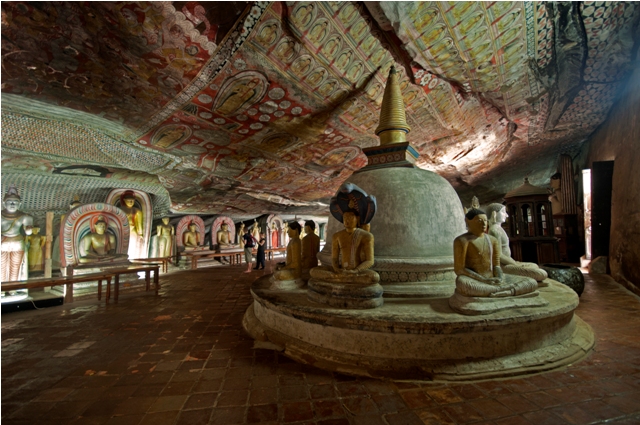
On the way to the mythical city of Kandy, I stop at the Dambullamountain that hides the best preserved temples and caves all over the country. At 160 meters high, it shelters more than 80 caves with different statues and frescoes that reveal the history and teachings of Buddha. Watch out! there are 364 steps and you have to see it Barefoot! At last I arrived in Kandy and, transported by a tuk-tuk red color Ferrari, I cross local roads until arriving at house of Rajhu. This half-Sinhalese half-Norwegian painter and musician wears a simple loincloth, and lives in a simple but exquisitely decorated house on top of a hill with incredible views over the valley of the Hunas which I happily shared for a while.
But let’s talk about Kandy. It was the capital of the Sinhalese kingdom until 1815 and, like many other places in the country, it is also a World Heritage Site by UNESCO. Built around an artificial lake, it houses one of Asia’s most important religious relics in the Buddha’s Tooth Temple. Tradition says that whoever has custody of the relic will have power on the island. July, is filled with pilgrims and begins the festival of EsalaPerahera where great processions with elephants dressed as party go out with dancers, acrobats and torches. At the exit you will be impressed by the Victorian buildings as if you were in another country. Vestiges of thepassage of the English.
Another visit? The Botanical Gardens. Mister Palipana, his director, discover me species like the Cola, trees with leaves with the shape of a butterfly, bamboos that grow more than half a meter up to 35 meters, orchids with figures of pigeons inside … has more than 4,000 species.
The paradise of the tea
Even if you are not addicted to this drink, you must have heard of Ceylon tea. In the mountainous area of The Hill Country, you will find one of the largest extensions of the world dedicated to this shrub. I arrived by local train to live a real journey back in time. The entire railway system is identical to those ones of the British era: wooden boards, staff uniforms, the ticket office (without a single computer). On the train there is only air conditioning in first class, and in that way I went between hills and tea-covered mountains, pure green gold from which I receive a masterful lesson thanks to Andrew Taylor, director of the plantation.
The nearby town of Nuwara Eliya, also known as Little England, was the capital of the tea empire during British times. Thanks to its cool climate, this area became the favorite for the settlers for their leisure. The hotels Grand Hotel and Hill Club were luxurious private clubs that, today, despite their decadence, maintain the flavor of the time with the original decoration.
I leave the mountains on my way to the South-East, this time by helicopter. The landscapes from the air, with hills, waterfalls and plantations, seem taken out from a painting. Landing in Yala National Park, to find out what’s really in the myth of the leopards of Sri Lanka. Here they have the largest population in the country. Camp Leopard Safaris is my center of operations and its owner, Noel, serves as an African-style guide. After two hours waiting, we discovered a pair of leopards resting next to some bushes.
Yala covers 98,000 hectares, has three ecosystems, is home for 215 species of birds and 44 species of mammals. Most visible are their elephant herds (you can see up to 350 together) and their crocodiles.


Galle final point
I border the south coast towards Galle, a picturesque key town in the spice trade for the Portuguese. They settled here to monopolize the trade in cinnamon, which, at that time, was literally worth its weight in gold. Today it is more accessible but Sri Lanka produces 19 percent worldwide. My guide here is Juliet, a British journalist sent to cover the 2004 tsunami, who fell in love and married her interpreter. She is one of the greatest connoisseurs of the history and corners of Galle Fort. A stone fortress from the 16th century, converted into a living monument of history. In its streets you can taste the European and Asian mix and, of course, it is UNESCO’s cultural heritage.
In this special place I end my journey in a plan that has been going on for centuries, a kind of ritual that consists of going to the old walls at sunset to admire – in silence – the sunset over the sea.


