


Summer is here and the beaches are full of people. Everyone with their mobile phone taking pictures to have the best memory or the best picture to post on social networks.
We can take panoramic shots, group shots, jumps over the waves, romantic sunrises and sunsets, even night shots.
But there is something that remains out of everyone’s sight and that holds an unknown beauty that deserves to be photographed and that will take our photos to another level; we are talking about those under the surface; we are talking about underwater photography.
Until recently, to take underwater photographs you had to buy very expensive equipment that was very complicated to use and required delicate maintenance.
We are talking about cameras for normal use, which had to be placed in an underwater housing specially designed for each model and which did not always give the desired results.


With the advances in mobile phone photography, several underwater housing manufacturers have come out with models that are ready to take our mobile phones and make underwater photography more accessible.
But what does it take to take a good underwater photo?
Waterproofing or how to keep your device safe from the water
The purpose of a waterproof case is to keep your mobile phone completely dry and to facilitate access to the phone’s photographic functions.
As we have mentioned, several manufacturers have launched underwater cases for cell phones. There are usually different models depending on the size of the phone and whether they are Android or Apple phones, so we will have to look for a case suitable for our phone.
These cases are very easy to handle and configure, but they do require a certain amount of care, even if it is minimal, they have to be meticulous. It is essential that we take a few minutes to read the instructions of the case if we do not want to end up with our mobile phone drowned by the misuse of the case.
One of the most important elements of the case is the O-ring. This is a round rubber gasket that makes the case watertight. Its price is very low but it is essential for the proper functioning of the housing. Every time we close the housing, we have to make sure that the O-ring is perfectly clean and stretched. Any dirt that remains on it, even a simple hair, will make the housing not watertight and water will enter as soon as it is submerged.


The care that an O-ring needs is minimal, but essential to its proper functioning. The easiest way to clean the O-ring is to remove it from its case using the plastic extractor usually supplied with cases. Once out of the housing, clean it very gently with water and neutral soap, without stretching it, and dry it with a clean cloth. Once dry, we carry out a visual inspection to look for any deterioration of the seal. If we find the slightest flaw in the material, it must be discarded. Before putting it back into the case, we hydrate it with silicone grease to maintain its properties.
We must not forget that when we finish our underwater photography session, before opening the housing, we must wash it well to remove the remains of the salt so that it is ready for the next session.
Once we’ve got our case ready, let’s get ready to take a good underwater photo.


It is important to remember that light behaves differently underwater than on the surface, losing intensity and colour with depth. If we are taking pictures at shallow depths, we will not need any other accessories, but the most daring and experienced freedivers will notice that their pictures will have a bluish tone. These bluish tones can be corrected with special software applications or artificial lighting.
Another point to consider is suspended particles. We need to move away from crowds and avoid touching the background so as not to lift the sand and end up with a blurry photo full of sand.

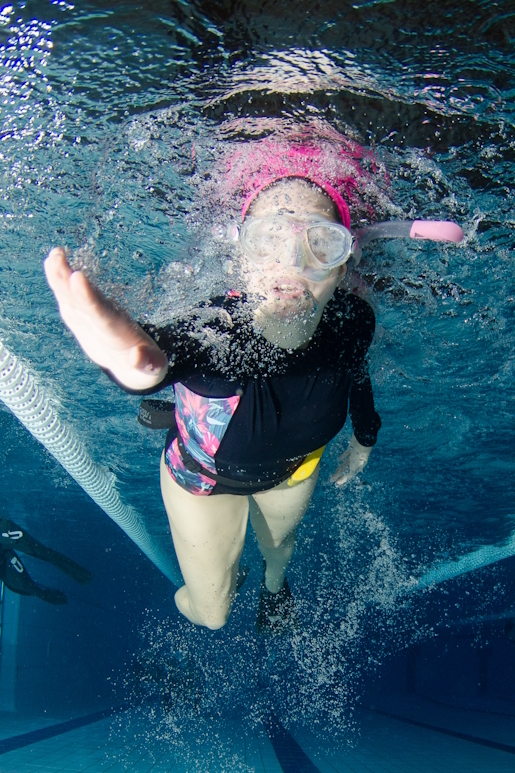
Finally, there is a very important rule to follow: never disturb the marine life. Let’s not forget that we are guests in the sea where a multitude of creatures live and we must respect them and the environment in which they live. I invite you to make the phrase “leave bubbles and bring back memories” your own.
Collaborating company Asparla Intova S.L.
Credits José Muélledes [FMDAS] [AQUAS]

